No Menu, No Problem: Why Handing the Chef Full Control Might Be the Most Personal Meal You'll Ever Have
There's a particular kind of anxiety that comes with a restaurant menu the size of a small novel. Too many options, too many trade-offs, too many moments of second-guessing yourself right up until the server reappears. Now imagine the opposite: you sit down, maybe share a few words about allergies or strong dislikes, and then you simply... wait. No laminated pages. No scanning QR codes. No agonizing between the halibut and the duck.
That's omakase — a Japanese term that roughly translates to "I leave it up to you" — and it's one of the most counterintuitive dining formats to have taken hold in American restaurant culture. The idea that removing choice from the equation could somehow make a meal feel more personal, more tailored, more you? It sounds like a paradox. But spend an evening at one of the country's serious omakase counters or chef's tasting tables, and the logic starts to click.
What "I Leave It Up to You" Actually Means
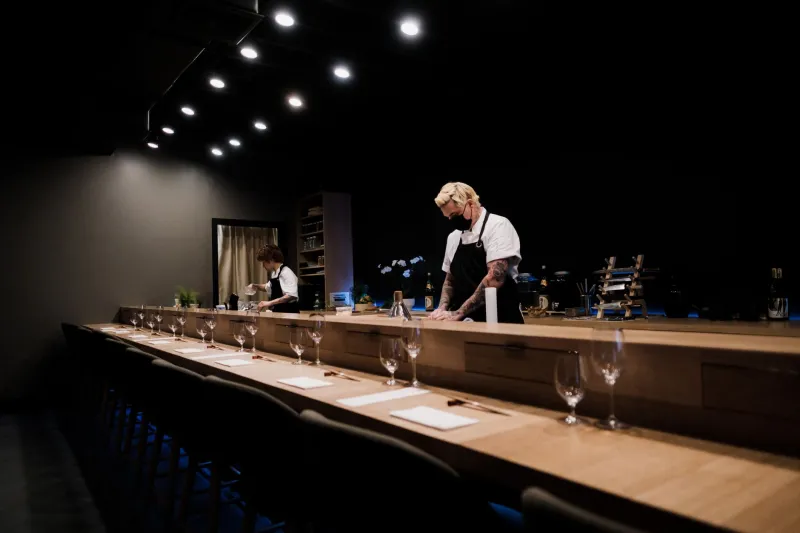
Omakase originated in Japanese sushi culture, where a chef would craft a progression of nigiri based on what the market yielded that morning, what the season demanded, and — crucially — what they read from the guest sitting in front of them. It was never random. It was responsive.
That responsiveness is what separates a true omakase experience from a prix fixe dinner where everyone at every table gets the same seven courses in the same order. At its best, omakase is a conversation without words. The chef watches how you react to a piece of fatty tuna. They notice whether you lingered on the uni or moved past it quickly. They adjust.
"When someone sits down at my counter, I'm not thinking about the menu," says one Chicago-based sushi chef who runs an intimate twelve-seat omakase experience. "I'm thinking about them. What do they seem like? Are they here to be adventurous or are they here to be comforted? That changes everything I put in front of them."
That kind of attention is rare in traditional dining. When you order off a menu, the kitchen executes your request — skillfully, hopefully — but the relationship stays transactional. With omakase, something shifts. The chef becomes an author and you become the subject.
The Psychology of Culinary Trust
Handing over control isn't easy for everyone. American dining culture, in particular, has long celebrated customization. We want our orders exactly the way we want them. Hold the onion. Sauce on the side. Dressing on the side of the side. There's nothing wrong with that — knowing what you like is a good thing — but it does create a particular mindset that omakase asks you to set down at the door.
What's interesting is what happens psychologically when you do. Researchers who study decision fatigue have noted that reducing choices often increases satisfaction with outcomes. When you've agonized over a menu and made your selection, you've already invested mental energy in justifying that choice before the food even arrives. With omakase, that burden disappears. You're free to simply receive.
Diners who've made the switch — even reluctantly — often describe a kind of relief. "I went to my first tasting menu experience dragging my feet," admits one food-obsessed New Yorker who now seeks out omakase counters on every trip she takes. "I thought I'd be annoyed not getting to pick. Instead, I was completely present for the whole meal. I wasn't planning what came next. I was just eating."
That presence, it turns out, makes everything taste better.
When the Chef's Story Becomes Yours
One of the things that makes chef-driven tasting menus so compelling is that they're inherently narrative. Great chefs don't just cook food — they sequence it. The meal has a shape: a quiet, precise opening, a building middle, a moment of richness or surprise, a gentle resolution. It's architecture you eat.
At Minibar in Washington D.C., at Smyth in Chicago, at n/naka in Los Angeles — these aren't just restaurants, they're extended expressions of a chef's point of view. Every course is a deliberate choice, placed exactly where it is for a reason. When you surrender the menu, you're agreeing to follow someone else's logic, and that logic — when it works — feels almost uncannily like it was made for you.
Part of that is the pre-meal intake process that serious omakase restaurants now treat almost like a ritual. Dietary restrictions, of course, but also: What flavors do you gravitate toward? Is there anything you particularly love? Anything that brings up a bad memory? Some restaurants send questionnaires days in advance. Others have a quiet conversation at the start of service. Either way, the chef is building a picture of you before they build your meal.
"I ask people about their childhoods," says a tasting menu chef based in Nashville who designs a rotating eight-course experience. "Not in a weird way. But food is memory. If someone mentions their grandmother's lemon cake, I'm going to find a way to work citrus into something before the night is over. That's what makes it personal."
Is It Worth the Price?
Let's be honest: omakase and chef's tasting menus aren't cheap. In major American cities, you're often looking at $150 to $400 per person before drinks, and the top-tier experiences can push well beyond that. It's a significant investment, and it's fair to ask whether the format itself justifies the cost.
The argument for it is that you're not just paying for ingredients — you're paying for curation. For editorial judgment, essentially. Someone has made hundreds of decisions on your behalf, and the value of that depends entirely on how skilled and thoughtful that someone is. A mediocre tasting menu is a slog. A great one is a genuine experience you'll be talking about for years.
For diners who approach restaurants as a form of cultural engagement — not just fuel or entertainment — that distinction matters enormously. At TriMenu, we think the best meals are the ones that leave you with something: a memory, a new flavor reference point, a dish that rewired your understanding of what an ingredient could do. Omakase, at its finest, delivers all of that.
Letting Go at the Table
The omakase paradox isn't really a paradox at all, once you've lived it. Yes, you give up control. But what you get in return is a chef's undivided creative attention, a meal shaped around you rather than around a static menu, and the rare experience of being genuinely surprised by your own dinner.
In a food landscape that's increasingly about personalization — customized orders, dietary-specific menus, build-your-own everything — omakase takes the opposite bet. It says: trust us. We see you. We've got this.
And more often than not, that trust is exactly what makes the meal unforgettable.