Hiding in Plain Sight: How Restaurants Bury Their Best Desserts (And How to Find Them)
Here's a scenario that probably sounds familiar: you finish a genuinely great dinner, your server asks if you'd like to see the dessert menu, and you wave them off with a polite "we're good, just the check." Maybe you were full. Maybe you assumed the sweets weren't worth the extra twenty minutes. Maybe the whole idea just didn't occur to you.
But what if there was a pastry chef back in that kitchen who had spent three days perfecting a brown butter financier with miso caramel? What if the dessert section — buried on the back panel of a laminated tri-fold, listed in the same font size as the side dishes — was quietly the best part of the menu all along?
Restaurants, sometimes intentionally and sometimes not, have a habit of obscuring their dessert programs. And once you start noticing it, you can't really stop.
The Menu Real Estate Problem
If you've spent any time thinking about how restaurant menus are structured, you know that placement isn't random. The upper-right corner of a single-page menu gets the most eye traffic. Items listed first and last in any category tend to be remembered more than those in the middle. These aren't secrets — they're documented principles that menu engineers and restaurant consultants use every day.
So where do desserts usually land? At the very end, often on a separate card, sometimes only brought to the table after you've already signaled that you're winding down. By the time most diners encounter the dessert section, their decision-making energy is depleted. They've been reading, choosing, and eating for the better part of two hours. The cognitive load of evaluating a chocolate soufflé versus a seasonal sorbet feels like a lot when you're already satisfied.
This isn't necessarily malicious — it's just the logic of meal structure. But it does mean that desserts rarely get the same considered attention as the appetizers and mains that diners study before they've taken a single bite.
When Pricing Sends the Wrong Signal
There's a subtle pricing dynamic that plays out on a lot of menus, and it consistently undercuts desserts. A restaurant might price a starter at $18, an entrée at $42, and then list every dessert at $11 or $12. On the surface, that seems reasonable — desserts are smaller portions, lighter on ingredients. But what that pricing structure communicates, whether the restaurant intends it or not, is that the sweet course is an afterthought.
Contrast that with a place like a high-end tasting menu restaurant where dessert courses are priced comparably to savory ones, sometimes even highlighted as signature items. When a restaurant charges $22 for a plated dessert and gives it a full description with sourcing notes, it signals that this isn't garnish — it's a destination.
Mid-range restaurants are often caught in the middle. They have talented pastry talent in the kitchen but haven't figured out how to position those dishes in a way that justifies a higher price point or commands real attention from guests. The result is a dessert section that looks like a list of standard-issue options even when it isn't.
The Savory Hangover Effect
There's another force working against dessert: the meal itself. By the time you've worked through a charcuterie board, a bowl of pasta, and a glass or two of wine, your palate has been through a lot. Rich, savory, umami-forward flavors tend to linger. They can make sweetness feel like overkill — even when the dessert in question is precisely calibrated to cut through that richness.
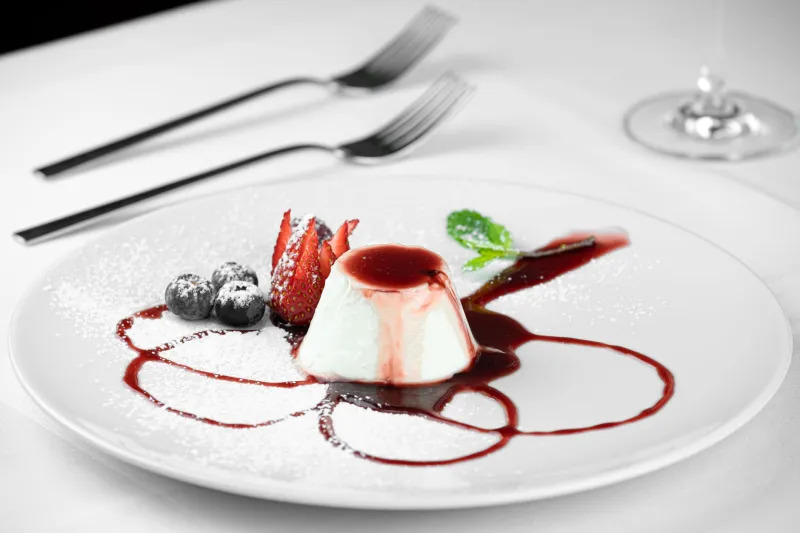
Good pastry chefs know this. They design desserts with acidity, texture contrast, and restrained sweetness specifically to work after a heavy savory meal. A well-made citrus panna cotta or a buckwheat crepe with salted honey is nothing like the sugar bomb your brain is bracing for. But if the menu doesn't communicate that — if it just says "vanilla panna cotta, $10" — you're not going to pick up on the nuance.
This is where descriptive menu writing earns its keep. Restaurants that invest in language that actually explains what a dessert tastes like — not just what it contains — tend to sell more of them. "Lemon curd tart with chamomile cream and candied thyme" tells a story. "Lemon tart" does not.
How to Spot a Serious Pastry Program
So how do you know, before you've ordered anything, whether a restaurant's desserts are worth saving room for? A few signals to look for:
A dedicated pastry chef is credited somewhere. If the restaurant's website or menu mentions a pastry chef by name, that's a strong indicator that the sweet program is a real priority, not an afterthought handled by a line cook at the end of service.
Seasonal ingredients show up in the dessert section. If the savory menu changes with the seasons but the desserts list the same crème brûlée year-round, that's telling. A kitchen that cares about its sweet course updates it just as often as everything else.
The descriptions are specific. Vague dessert listings — "chocolate cake," "ice cream" — suggest they're not expecting you to order them. Detailed, evocative descriptions mean someone wants you to.
There's at least one unusual option. A dessert menu with nothing but tiramisu, cheesecake, and lava cake is playing it safe. One that includes something unexpected — a savory-leaning option, an unfamiliar grain, a fermented dairy element — is a kitchen that's actually thinking.
The Ask That Changes Everything
Here's the simplest move in the book: ask your server what the pastry chef is proud of. Not "what's good for dessert" — that gets you the crowd-pleasers. Ask what the kitchen is excited about, or whether there's anything that doesn't get ordered enough. You'll be surprised how often that question unlocks a genuine recommendation from someone who actually knows.
At TriMenu, we spend a lot of time thinking about how the full arc of a meal comes together — and dessert is part of that arc. Skipping it isn't inherently wrong, but doing it reflexively, without even glancing at what's on offer, means you might be walking away from the most memorable bite of the night.
Next time you sit down to dinner, flip to the back of the menu before you order anything else. See what's there. Then decide.
Chances are, someone worked hard on it.