Produce on the Margins: How to Tell If a Restaurant Truly Respects Its Vegetables

Photo by Photo by Louis Hansel on Unsplash on Unsplash
There's a quiet deception happening on menus across America, and most diners never notice it. A restaurant lists a side of roasted Brussels sprouts. Another offers a grain bowl crowned with "seasonal vegetables." A steakhouse proudly advertises its "garden accompaniments." All of it sounds wholesome, even generous. But pull back the curtain, and you'll often find the same story: vegetables shoved to the margins, treated as decoration, or hidden so thoroughly in a dish that they barely register.
This isn't always intentional sabotage. Sometimes it's habit. Sometimes it's a kitchen built around proteins that never quite figured out what to do with a carrot. But for diners who actually care about eating well — who want nutrition, flavor, and a sense that the kitchen gave a damn — knowing how to spot genuine vegetable respect versus performative produce is a genuinely useful skill.
Why Restaurants Play Hide-and-Seek with Vegetables
Let's start with the business reality. Vegetables are tricky. They're perishable, labor-intensive to prep, and — in the minds of many conventional restaurant operators — a harder sell than a ribeye or a pasta loaded with cream. There's a long-standing assumption in the industry that diners want vegetables present but not prominent. Enough to feel virtuous, not enough to feel like they're missing out.
That assumption shapes menus in ways most people don't consciously register. A burger comes with a thin slice of tomato and a leaf of iceberg. A pasta dish buries spinach under enough cheese that it's nutritionally invisible. A grain bowl features "roasted vegetables" that turn out to be four cubes of sweet potato and a scattering of corn. The vegetables are there, technically. But they're not doing much.
There's also a flavor-masking dynamic at play. Heavy sauces, excessive salt, and rich fats can make it genuinely difficult to taste — or even identify — what vegetables are in a dish. That's not always a bad thing culinarily, but it can be a way of making produce palatable to diners who might otherwise push it to the side of the plate.
Red Flags in Menu Language
Menus are marketing documents, and the language they use about vegetables is revealing. A few phrases worth scrutinizing:
"Seasonal vegetables" with zero specifics. When a menu doesn't name the actual vegetables, it's often because the kitchen is using whatever's cheapest or most convenient that week. A kitchen that's genuinely excited about its produce will tell you it's charred leeks or roasted delicata squash — not just "seasonal veg."
"Garnished with" or "served alongside." These phrases signal that the vegetable is an afterthought. It's there to add color to the plate, not to contribute meaningfully to the dish.
"Hidden" or "sneaked in" as a selling point. Some menus — especially in family-friendly or fast-casual contexts — will actually brag about hiding vegetables in a sauce or smoothie. That's a red flag for adults who want to eat intentionally. If the kitchen's approach to produce is concealment, that tells you something.
Vague preparation language. "Cooked vegetables" or "mixed greens" gives you nothing. Contrast that with "wood-roasted broccolini with calabrian chili and lemon zest" — that's a kitchen that's actually thought about what it's doing with a vegetable.
Plating Tricks That Minimize Produce
Beyond language, there's the visual reality of what lands on your table. Restaurants use plating to communicate value, and vegetables are often the losers in that equation.
Watch for the protein-center rule: a large cut of meat or fish placed dead center on the plate, with vegetables arranged around the edges in small quantities. The visual message is clear — the protein is the star, and the vegetables exist to frame it. That's not inherently wrong, but it's worth noting when you're evaluating a restaurant's culinary philosophy.
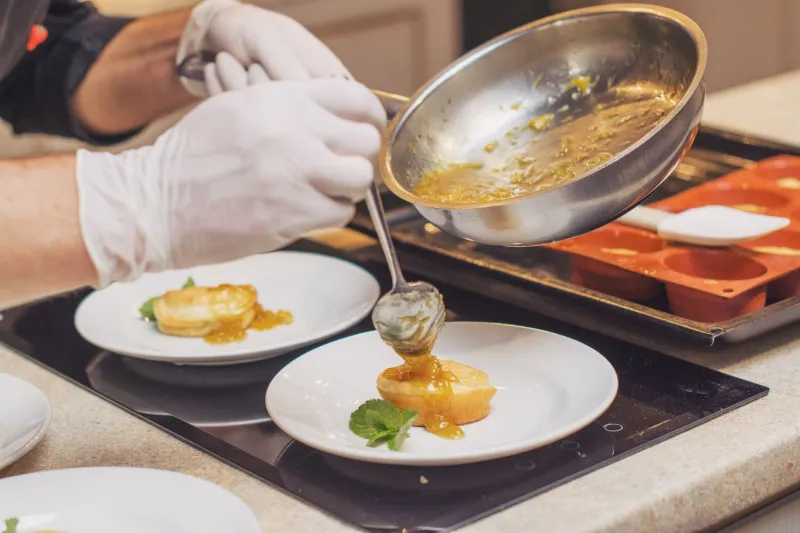
Another common trick is the heavy glaze or sauce pour. A beautiful roasted cauliflower can disappear under a thick romesco or a pool of tahini. Again, not always bad flavor-wise, but it can obscure the actual quality — or lack thereof — of the vegetable itself. A kitchen confident in its produce prep often lets the vegetable speak with minimal intervention.
Portion ratios also tell a story. If your "vegetable plate" arrives and the starch component (potatoes, rice, bread) visually dominates, the restaurant has made a quiet editorial choice about what matters on that plate.
What Genuine Vegetable Respect Actually Looks Like
So what separates a kitchen that truly celebrates produce from one that's just going through the motions? A few reliable signals:
Vegetables get their own section, not just a footnote. Menus that dedicate a full section to vegetable dishes — not just "sides" but actual composed vegetable courses — signal that the kitchen has invested real thought in this category.
Sourcing is mentioned specifically. When a menu credits a local farm for its tomatoes or specifies that its greens come from a regional grower, that's a kitchen paying attention. It's not just marketing; it usually means the chef is building dishes around what's actually good right now.
Preparations are varied and specific. A restaurant that roasts, ferments, pickles, raw-prepares, and chars vegetables across its menu is a kitchen that understands produce as a diverse category — not a monolith of steamed broccoli.
Vegetable dishes are priced like they matter. This one surprises people, but a $22 composed vegetable plate is often a better sign than a $6 side of roasted vegetables. Price reflects labor and intention, and a kitchen that charges appropriately for vegetable dishes is one that's actually putting work into them.
How to Ask the Right Questions
You don't have to be a detective to eat better. A few simple moves can tell you a lot before you commit to a meal.
Ask your server what the kitchen is most excited about right now — not what's most popular, but what the cooks are actually proud of. If the answer immediately goes to a protein, that's information. If they mention a specific vegetable preparation with genuine enthusiasm, that's also information.
For restaurants with online menus, look at how frequently the menu changes. A seasonal rotation suggests a kitchen following the produce calendar. A static menu that never changes is often a kitchen working from a fixed playbook that doesn't prioritize freshness.
And when in doubt, order a vegetable dish early in your meal — a salad, a small plate, an appetizer built around produce. The quality of that dish will tell you more about a kitchen's priorities than almost anything else on the menu.
Vegetables deserve better than the margins. The restaurants that know that are worth finding — and worth going back to.